Plants Good for Bees: 10 UK-Friendly Choices
Discover 10 plants good for bees, with practical UK planting advice for gardens, beds, containers, green roofs and low-maintenance pollinator patches.
In this article
- 1. Phacelia
- A useful choice for short-term cover
- 2. Borage
- Let it seed, or keep it contained
- 3. Red Clover
- Give the flowers time
- 4. Lavender
- Keep pruning light
- 5. Wild Marjoram
- Establish it where it can compete
- 6. Sunflower
- 7. Ivy
- Protect the autumn flowers
- 8. Crocus
- Delay the first cut
- 9. Purple Coneflower
- Use it as part of a wider mix
- 10. Common Knapweed
- Manage the meadow, not just the flowers
- Top 10 Bee-Friendly Plants Comparison
- Turn Planting into a Repeatable Sustainability Action
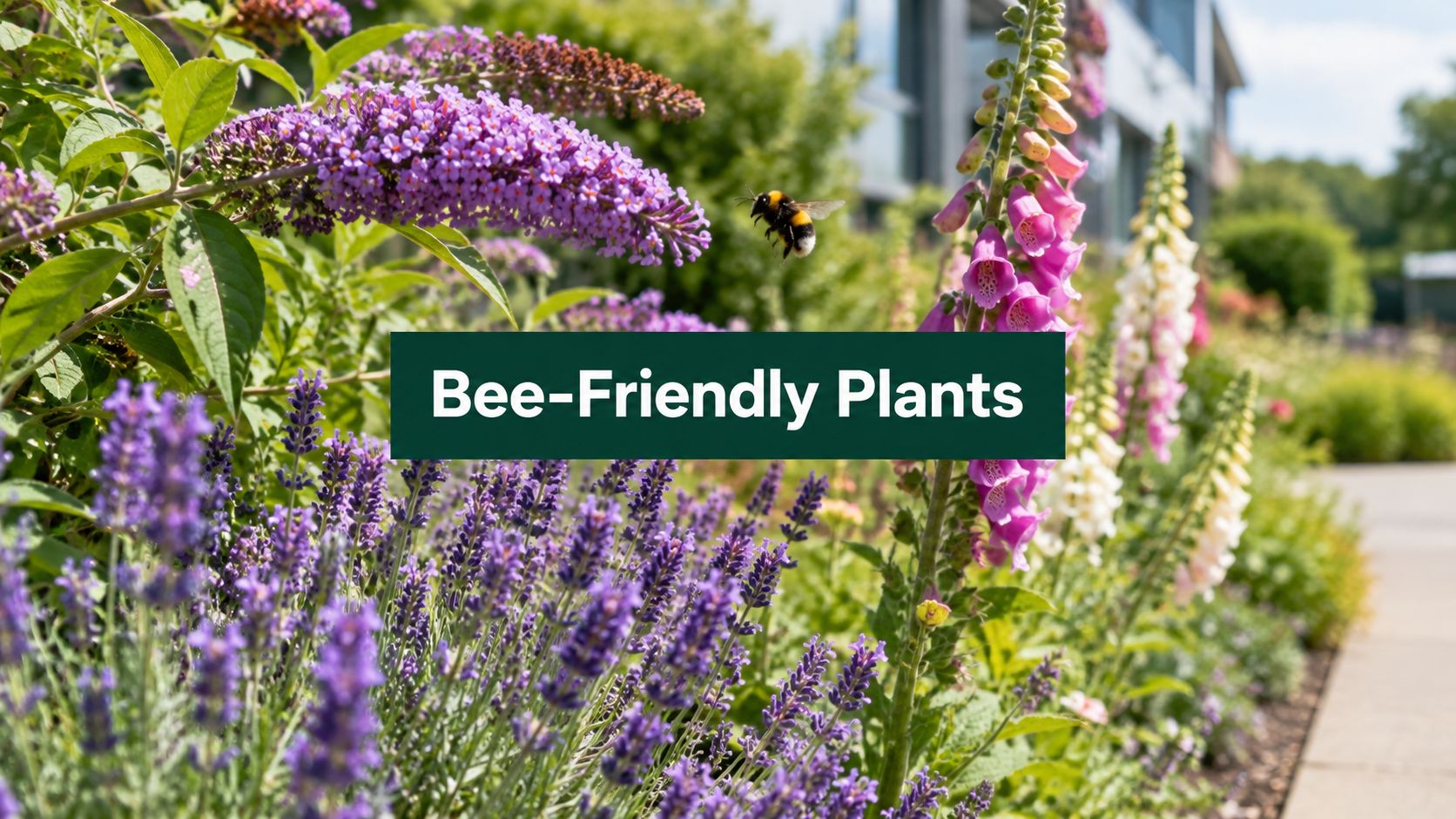
The best plants good for bees are those that provide reliable nectar and pollen across a long season, suit the site's conditions and can be maintained sustainably. The UK has approximately 25 bumblebee species and 260 solitary bee species, alongside one honeybee species, so no single plant is best for every site. UK Government guidance on bees and their food
You're choosing a few bee-friendly plants for a workplace border, school ground, car park or reclaimed patch of land. A colourful display can look promising, but if everything flowers at once, grows poorly in the soil or needs more care than your team can provide, it won't offer dependable forage for long.
Good pollinator planting depends on continuity, variety, suitable growing conditions and realistic maintenance, not just decorative appeal. The UK's pollinators include bees as well as hoverflies, wasps, flies, beetles, butterflies and moths. A varied planting scheme can serve more of them than a site dominated by a single ornamental plant. For farming land, the benefit extends beyond appearance: insect pollination contributes about £600 million to UK crop value through increased yields and improved seed and fruit quality, according to the same government guidance.
The ten choices below suit different jobs, from quickly covering bare ground to building long-lived habitat. Match each plant to its flowering period, soil, light and the time available for upkeep. Choose responsibly sourced plants, avoid pesticide use where possible, and plan how you'll manage clippings and other green waste.
1. Phacelia
Bare or disturbed ground doesn't have to remain a missed opportunity. Phacelia (Phacelia tanacetifolia) is a fast-growing annual that can provide flower cover while a larger planting plan takes shape. Its lilac-blue flower clusters are frequently visited by bees, and its quick establishment makes it a practical choice for temporary beds, field margins and land awaiting restoration.
Sow in spring for summer flowers, or in late summer to extend the display into autumn. Prepare a fine, firm seedbed, scatter the seed thinly and rake it in lightly. For a looser, more varied patch, sow it with cornflower or poppy rather than relying on one uniform block.
A useful choice for short-term cover
Phacelia suits a site team that needs a straightforward annual, but it isn't a replacement for permanent habitat. It needs resowing if you want to maintain a planned display, and it can self-seed if flowers are left to mature. Decide whether you want it to set seed before the season starts, then include that decision in the maintenance schedule.
Practical rule: Use phacelia to quickly bring flowers to bare ground, then assess whether the site needs a lasting meadow or perennial planting.
A spring sowing can be one part of a seasonal sequence, with later-flowering plants taking over as phacelia fades. For teams developing a broader grounds programme, Gegan's environmental-management resources can sit alongside a site plan that considers planting and waste systems together.
2. Borage
Borage (Borago officinalis) adds striking blue, star-shaped flowers to vegetable beds, school gardens and community growing spaces. Its flowers hang downwards, and bees can readily visit them. The plant also works well where a site benefits from flowers that can be used in the kitchen, provided it's grown without pesticides and handled appropriately for its intended use.
Sow directly in a sunny spot in spring, once frost risk has passed. Borage is an annual that often self-seeds, so it may return without being replanted. That can be a benefit in an informal community garden, but it may be unwelcome in a carefully controlled border.
Let it seed, or keep it contained
If you want to prevent it spreading, cut back spent plants before they set seed. If you're happy for it to return, leave some flowers to mature and monitor where new seedlings appear. Remove unwanted seedlings while they're small rather than letting the planting become difficult to manage.
The plant's relaxed form suits herb plots better than tightly clipped formal beds. Pair it with other flowering herbs or vegetables, and make sure volunteers know whether flowers are intended for pollinators, food use, or both. For teams researching how to measure and communicate their work, Gegan's guide to quantitative research offers a related starting point for thinking about evidence and measurement.
3. Red Clover
Where the aim is to build a meadow or improve a low-input field margin, red clover (Trifolium pratense) is a practical native perennial or short-lived perennial legume. Its pink-red flower heads are especially accessible to long-tongued bumblebees, and the plant can also contribute to soil fertility by fixing nitrogen through root nodules.
Sow in spring or autumn on low-fertility ground. Rich, vigorous grass can crowd clover out, so reduce competition before sowing and avoid applying fertiliser that encourages grass growth. Red clover is used in wildflower meadow mixes and farm pollen-and-nectar mixes, and it can also play a role in agricultural rotations.
Give the flowers time
The timing of mowing makes a direct difference to the flowers available in the planting. Let red clover bloom before cutting, then remove cuttings where the management aim is to keep the soil relatively low in nutrients. Pair it with plants such as bird's-foot trefoil and common knapweed to broaden the flowering sequence.
Red clover isn't the best fit for a frequently mown ornamental lawn. It's more suited to meadow edges, larger grounds and places where a less formal appearance is acceptable. For teams documenting site improvements, Gegan's team profile provides background on the people behind its environmental-management work.
4. Lavender
For a sunny border beside a building entrance, car park or public walkway, English lavender (Lavandula angustifolia) offers structure as well as flowers. Its purple spikes are popular with bees in summer, while its evergreen-like shrubby form can give a planned garden a clear edge. It's also drought tolerant once established, provided the site has good drainage.
Plant in spring or early autumn in full sun. Lavender performs best in soil that drains well, so don't improve a poor site by adding rich compost indiscriminately. Overly lush growth can weaken the plant's shape. A gravelly bed or raised border may suit it better than a damp, heavy patch.
Keep pruning light
Trim lightly after flowering to maintain a compact shape, but don't cut into old wood. That makes lavender useful for gardens where staff can carry out a simple, predictable seasonal task, rather than frequent deadheading or intensive replanting.
Lavender's strongest role is in a sunny, well-drained border. Don't use it to fill a shaded or waterlogged space.
Lavender also appears on the Royal Horticultural Society's examples of plants that can help provide pollinator forage, alongside honeysuckle, bellflower and single-flowered roses. RHS guidance for choosing plants for pollinators explains how its recommendations draw on standardised observations of insects visiting plants. For a public-facing scheme, that gives grounds teams a sound reason to specify a suitable, open-flowered choice rather than relying on appearance alone.
5. Wild Marjoram
Wild marjoram (Origanum vulgare), also known as oregano, earns its place where a site needs late-summer flowers and a naturalistic look. The pink-purple flower heads attract bees, butterflies and hoverflies. As a plant native to much of Britain, it's a sensible fit for grassland-style planting and chalky, well-drained areas.
A school herb garden or community plot can use wild marjoram as both a flowering plant and a culinary herb. On a larger site, it works in a meadow edge or a wildlife border, especially where the soil isn't being enriched and taller grasses won't smother it.
Establish it where it can compete
Plug plants or cuttings can establish a patch more quickly than starting from seed. Keep grass competition low, and use occasional cutting to prevent vigorous surrounding vegetation from taking over. Avoid cutting the entire area while the flowers are in bloom; leave seed heads standing through winter where the site's appearance and safety requirements allow.
Wild marjoram is a better choice for a loose, wildlife-focused planting than for a formal bed that must remain sharply defined. Its late-season flowers also make it useful alongside early and mid-season plants, helping a scheme offer forage beyond a single summer flush.
6. Sunflower
A sunflower (Helianthus annuus) makes an immediate visual feature in a school garden, community growing space or pollinator border. Its large flower head contains many small flowers, and single-flowered varieties provide accessible pollen and nectar. Double-flowered forms often make those resources harder for insects to reach, so choose single blooms when pollinator value is the priority.
Sow in late spring after the soil has warmed, in a sunny, sheltered location. Sunflowers suit annual displays, but their height means they need space and may need support in exposed areas. Plan the position carefully so they don't shade out smaller plants or block sightlines around paths and entrances.
A line of sunflowers can bring a clear seasonal focus to a school garden, while a mixed border gives the planting more variety. Avoid using them as the whole pollinator scheme: their flowering period is limited, so combine them with plants that bloom earlier and later.
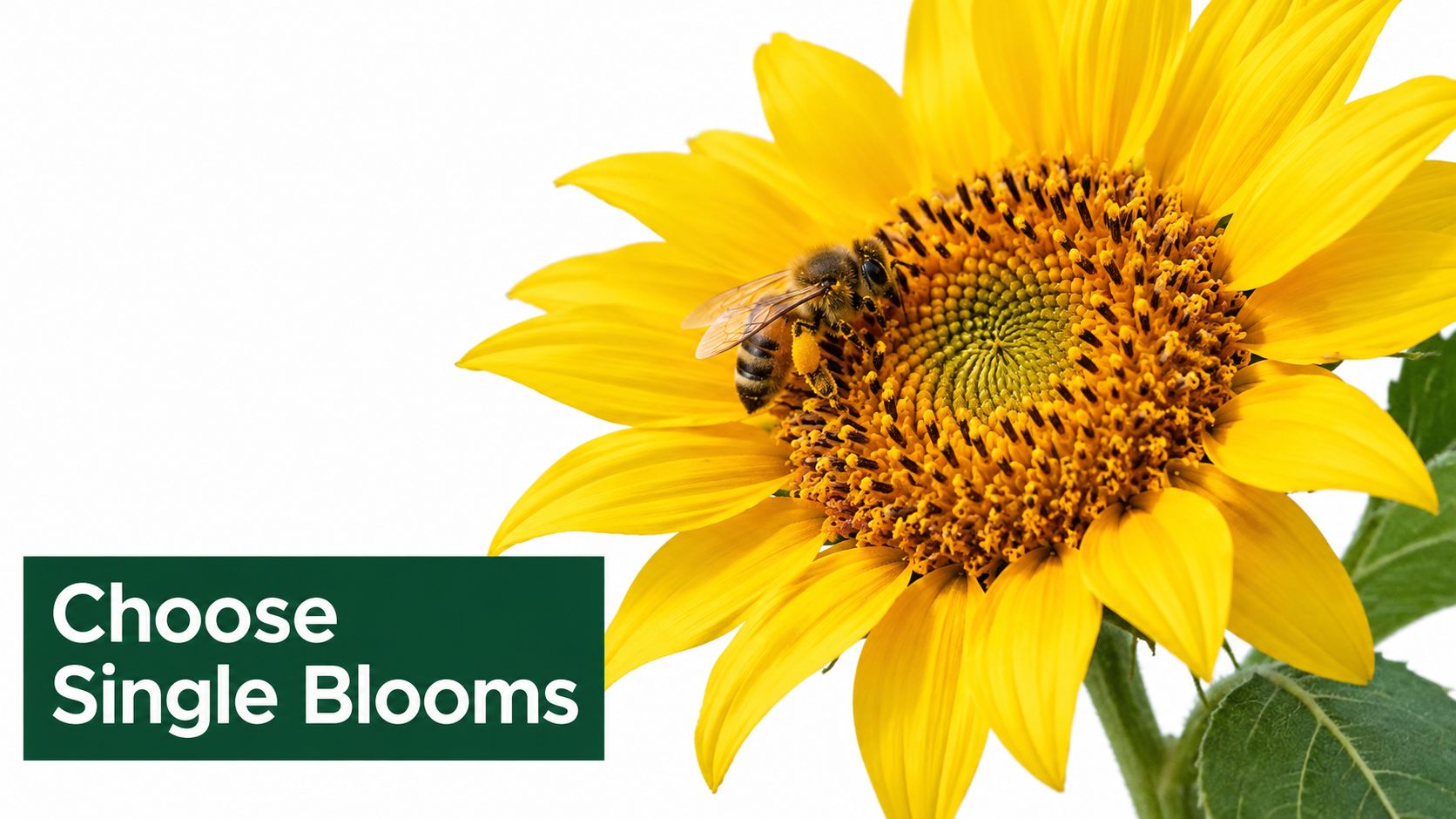
Leave the seed heads standing after flowering where site conditions allow. They can provide food for birds and save the team an unnecessary autumn clear-up. For a visual guide to planting and growing sunflowers, watch this short sunflower video.
7. Ivy
Common ivy (Hedera helix) is valuable when the rest of a planting scheme is winding down. Its flowers appear in autumn, offering nectar and pollen at a time when fewer plants are in bloom. Later, its berries can feed birds. For an industrial boundary or school fence, ivy can add habitat without taking up valuable ground-level planting space.
Guide it onto a fence or trellis, or use it as ground cover. Avoid planting directly against masonry if the building's condition or maintenance requirements make climbing growth unsuitable. Ivy is not a tidy, quick-turnover bedding plant, so agree where it can grow and how its spread will be managed before installation.
Protect the autumn flowers
Don't cut ivy while it's in flower if you can schedule the work at another time. That simple change helps preserve its late-season forage. Where trimming is needed, collect the cuttings and include them in the site's green-waste process rather than leaving them in access routes or drainage areas.
Ivy suits boundaries and less prominent corners better than every formal frontage. Its strength is its long-term role as cover and late forage, not a showy seasonal display. On commercial sites, treat it as part of the boundary-management plan: specify the support structure, access requirements and trimming schedule before it becomes established.
8. Crocus
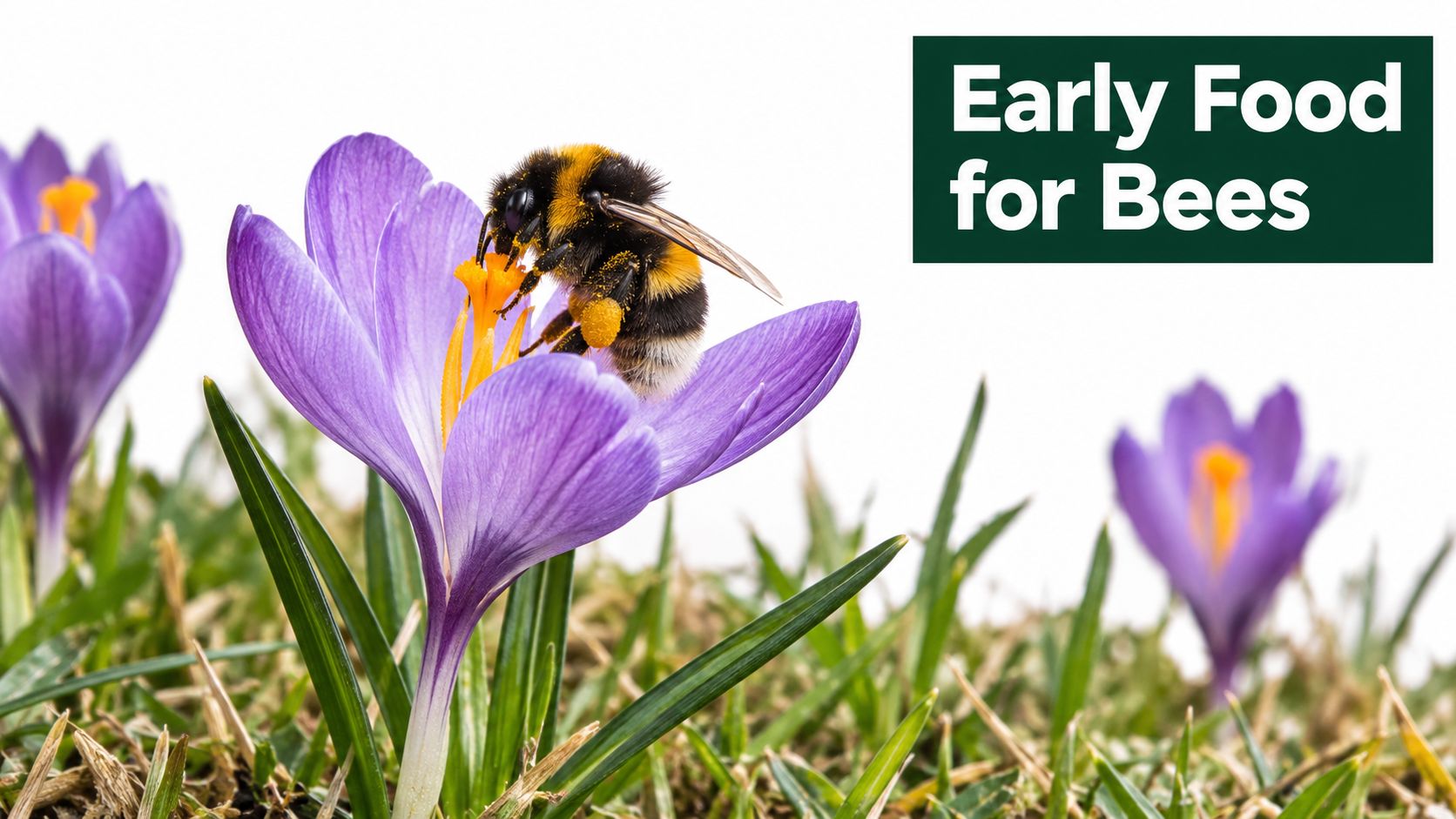
Crocuses (Crocus species) bring flowers to lawns and borders early in the year, when many other plants haven't yet started blooming. Bumblebee queens emerging from hibernation need access to early forage, making crocus a useful part of a planting plan that would otherwise begin too late in the season.
Plant bulbs in autumn in a sunny or lightly shaded spot with soil that drains well. Naturalise them in drifts through grass or scatter them through borders rather than planting isolated bulbs. In a park, hospital garden or public green space, groups of crocuses can provide an early display without requiring a large area of formal bedding.
Delay the first cut
The main maintenance decision comes after the flowers fade. Leave the foliage until it yellows so the bulbs can replenish their reserves, and delay mowing a naturalised lawn until that foliage has died back. If the grass must be cut earlier for access or appearance, keep the crocuses in a separate drift or border where mowing can be scheduled around them.
Crocus is an early-season addition, not a complete solution. Combine it with spring, summer and autumn flowers so a site doesn't offer forage only during its first burst of colour.
9. Purple Coneflower
Purple coneflower (Echinacea purpurea) is a North American perennial used in naturalistic and formal planting alike. Its raised central cone and pink-purple petals bring height and a clear focal point to a sunny border. Bumblebees visit its flowers, and butterflies also use the blooms.
Choose single-flowered forms, plant in full sun and provide soil that drains well. Purple coneflower works in a public garden or campus border where a strong visual design matters as much as wildlife value. It's less suited to a shaded, wet area or a site where staff need every plant to remain compact without seasonal management.
The flowers contribute to a summer planting, while the seed heads can remain upright after flowering. Leave them standing over winter where practical, both to retain structure and to provide food for birds. In spring, cut back the old stems as new growth begins.
Use it as part of a wider mix
Because it's not native to Britain, purple coneflower is best treated as a selected ornamental with pollinator value, not a substitute for native meadow plants. Choose plants for their suitability, flowering period and accessibility to insects, and balance them with native species where the site supports a more naturalistic scheme.
That balanced approach matters because native-only planting isn't automatically the right answer for every site. Research reviewed by the UK Centre for Ecology & Hydrology found that some tested seed mixes combining native and non-native plants established well, flowered for longer and received visits from several types of bee. Research on seed mixes for pollinators and people supports choosing suitable, non-invasive plants based on evidence and local conditions, rather than relying on a simple native-or-non-native rule.
10. Common Knapweed
For a long-lived meadow or road-verge planting, common knapweed (Centaurea nigra) offers a native perennial with purple, thistle-like flowers. Bees, including bumblebees and solitary bees, visit the flower heads. Its deep-rooted growth makes it a strong choice for low-fertility grassland and other sites where a naturalistic appearance is appropriate.
Knapweed suits restored meadows, motorway margins and larger public grounds more than tightly managed lawn. Give it reduced competition from grasses, and avoid adding nutrients that would favour vigorous grass growth. In a designed meadow, combine it with other flowering species to create a longer and more varied display.
Manage the meadow, not just the flowers
Cut the meadow after flowering and seed set, then remove the cuttings to avoid feeding the soil. Cutting once or twice a year can help keep the site from becoming overgrown, though the timing should suit the planting and local conditions. Yellow rattle can also be included where vigorous grasses need to be suppressed.
Knapweed needs space and a management plan. It isn't a quick decorative fix for a narrow, high-traffic border, but it can form part of a durable wildlife area when the site team commits to suitable cutting and removal of arisings.
Top 10 Bee-Friendly Plants Comparison
Choosing from ten good plants is a site-management decision: which species fits your soil, how much maintenance your team will do, and when the flowers land. The ratings below compare all ten on the factors that decide success on a real site, including time to first flower, shade tolerance and the risk of a plant spreading beyond where you put it.
| Plant | Season slot | Effort tier | Time to first flower | Shade tolerance | Spread risk | Best matched site |
|---|---|---|---|---|---|---|
| Phacelia (Phacelia tanacetifolia) | Early to mid-summer annual filler | Low | Roughly 6–8 weeks from sowing | Low: needs sun | Low: dies back each year | Field margins, temporary beds, disturbed ground |
| Borage (Borago officinalis) | Summer into early autumn | Low | Same season from a spring sowing | Low | High: self-seeds freely | Herb gardens, community plots, staff gardens |
| Red clover (Trifolium pratense) | Late spring through summer | Moderate | One to two seasons in grass | Moderate | Low | Meadows, farm margins, green manure strips |
| Lavender (Lavandula angustifolia) | Mid-summer | Moderate | Strongest from planted-out stock | Low: needs full sun | None: stays where planted | Commercial grounds, hospitality and retail sites |
| Wild marjoram (Origanum vulgare) | Late summer | Moderate | Same season from plugs | Low to moderate | Moderate: creeps slowly | Chalky soils, native beds, dry banks |
| Sunflower (Helianthus annuus) | Summer | Low | Same summer from sowing | Low | Low: annual | Schools, entrance beds, community gardens |
| Ivy (Hedera helix) | Autumn: a window most plants miss | Low to establish, then periodic control | Slow: mature growth needed before it flowers | High | High: climbs and carpets unchecked | Fences, trellises, boundaries, green walls |
| Crocus (Crocus species) | Late winter to early spring | Low | First spring after autumn planting | Moderate: works under deciduous canopy | Low: naturalises slowly | Lawns, borders, containers, tree bases |
| Purple coneflower (Echinacea purpurea) | Mid to late summer | Low to moderate | Often strongest from its second season | Low to moderate | Low | Pollinator borders, campuses, public gardens |
| Common knapweed (Centaurea nigra) | Summer into early autumn | Moderate | Two or more seasons to settle | Moderate | Moderate in open grassland | Wildflower meadows, road verges, restoration ground |
Read the table across rows rather than picking a favourite. A dependable scheme covers both ends of the season: crocus for emerging queens, ivy for the autumn gap, and one or two summer workhorses matched to your soil. If your maintenance budget is thin, the annuals (phacelia, borage, sunflower) deliver a season of flowers quickly while perennials like coneflower and marjoram establish in the background. High spread risk is fine on a boundary, less so beside a formal bed, so treat that column as a planning constraint.
Turn Planting into a Repeatable Sustainability Action
A planting project earns its keep when it becomes part of routine site management. A few well-chosen flowers can improve a border, but a planned mix delivers a more dependable range of pollen and nectar and gives grounds teams a clear, manageable maintenance job. Research on wild bee declines in Britain sets out the wider conservation context: protecting and improving habitat matters nationally, even though conditions differ from site to site.
Run this checklist before ordering seed or plants:
- Plan for different seasons: Combine early, mid-season and late-flowering plants so flowers aren't limited to a single period.
- Match the site: Check soil, light, available space and drainage, then select plants that can thrive there.
- Be realistic about maintenance: Set mowing, pruning and seed-head retention schedules your team can follow.
- Choose accessible flowers: Prioritise open, single-flowered forms, and avoid double-flowered cultivars where insect access is restricted.
- Source responsibly: Choose UK-native plants where they suit the project, and use non-native options only when they're suitable, non-invasive and supported by evidence of pollinator visits.
- Track what happens: Record flowering dates, how well plants establish and how much green waste the work produces.
Records matter. For businesses, schools and industrial sites, they turn planting into a working part of biodiversity monitoring and sustainability reporting. Grounds teams can also weigh whether flowering areas cut the need for frequently replaced bedding, and whether clippings and plant waste can go through a composting or green-waste route. Record what you do rather than claiming outcomes the site hasn't measured.
The UK supports many different pollinators, and a varied space offers more types of forage than a planting dominated by one ornamental. Flower variety and continuity across the season should guide your choices, applied alongside the site's practical constraints. A sunny car park edge suits lavender. A reclaimed patch does better with phacelia first and a meadow mix later.
Where environmental improvements need to connect with responsible waste and resource management, Gegan supports commercial organisations with waste and recycling services, transparent reporting and multi-site management. Pair a well-planned planting scheme with a clear process for handling its green waste, and keep records that show how both parts of the site plan are managed. If you're planning pollinator planting alongside better resource management, visit Gegan to discuss a practical approach to waste, recycling and sustainability reporting.