Causes of Desertification and How Soils Fail
The causes of desertification, how climate and land use interact, UK soil evidence, and practical steps that protect soil function.
In this article
- Why Desertification Starts When Soil Stops Holding Water
- The Main Causes of Desertification at a Glance
- Climate, grazing, and clearance
- Water, cultivation, extraction, and rules
- How Climate Stress and Land Use Reinforce Each Other
- What the exposure looks like in numbers
- Where the Same Causes Appear from Drylands to Britain
- How to read the UK rows
- Carbon, and the gap in the books
- What Lost Soil Costs Ecosystems and Livelihoods
- Ecological damage
- Livelihoods and the bill
- Land Management Responses That Break the Cycle
- Rules, contamination, and what "better" looks like
- Put Soil Resilience on the Business Agenda
- A review you can start this month
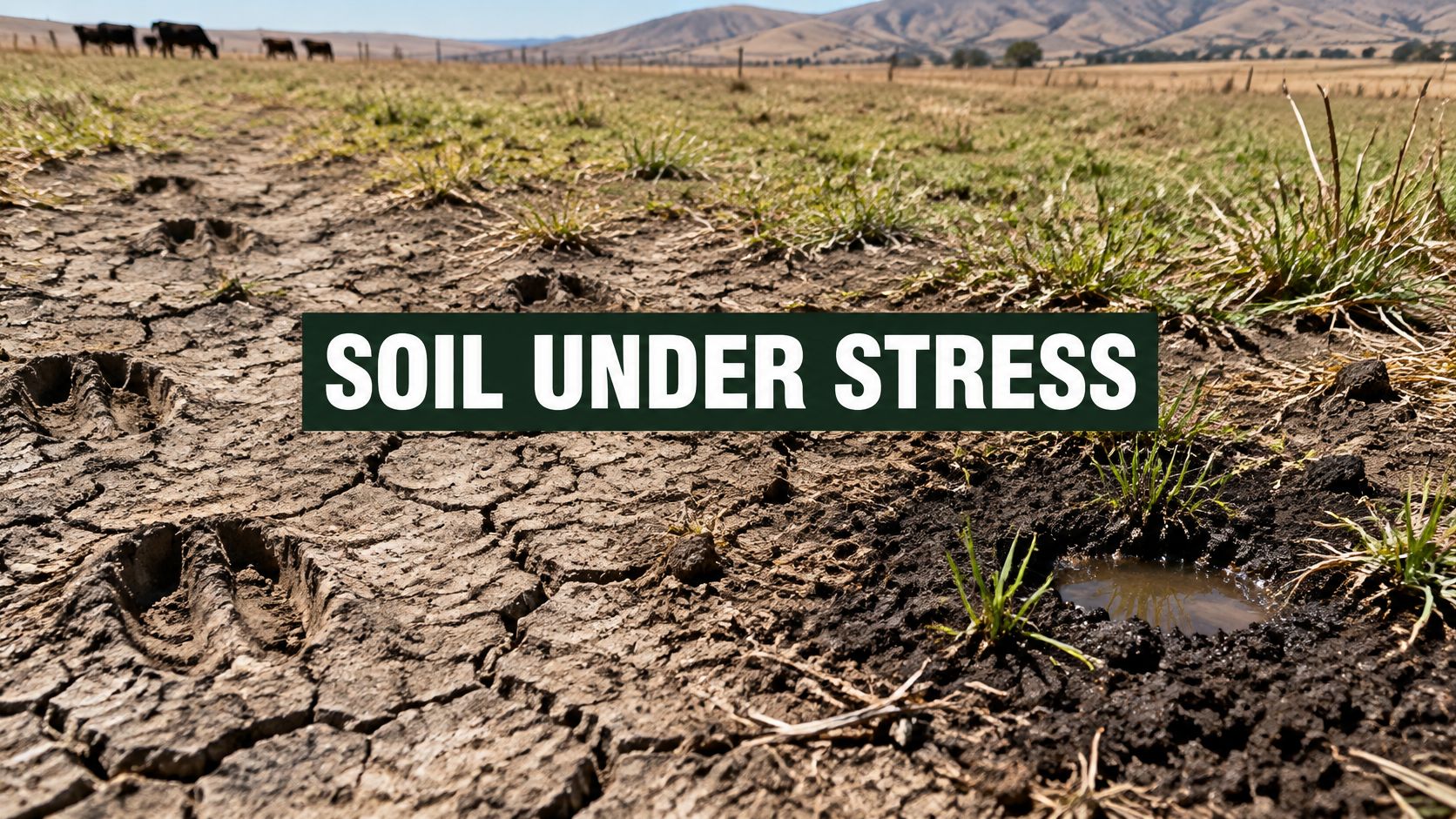
The usual advice treats desertification as a sand problem. Plant a belt of trees, the story goes, and the dunes will stop short of the village. That picture is easy to film and mostly useless for the land that is failing. Dunes are a late symptom. The causes of desertification start earlier, when soil stops acting like a sponge and starts acting like a roof.
Healthy ground takes in rain, holds it for roots, and keeps a dark store of carbon near the surface. Degraded ground can still look like a field. After a downpour it sheds water, crusts in the next hot spell, and grows less than it did a few seasons ago. You don't need a sand sea for that shift. You need cover, organic matter, and structure to collapse.
Britain is the awkward case. The climate is wet, yet the same loss of function is already under way on farms, peat, and building sites. What follows names the drivers, shows how climate stress multiplies them, traces them from dry rangeland to UK arable soil, counts the cost, and sets out the management choices that interrupt the failure. The test is simple. If the land stores less water and supports less growth than it used to, the causes are already active.
Why Desertification Starts When Soil Stops Holding Water
Say a winter cereal field in the Midlands takes a week of rain on already soft ground. The contractor still travels, because the spray window is short and the cattle need moving off a flooded yard. Wheelings smear the surface. Hooves punch the gateways. By March the tramlines hold water while the crop between them yellows. Nothing about that field looks like the Sahara. The sponge has still failed.
Desertification is land degradation in which climate variation and human activity strip biological productivity. Textbooks place it in drylands. The same collapse of cover, organic matter, and structure shows up on temperate farmland. Think of soil as a kitchen sponge. A good sponge drinks the spill, feeds the roots, and keeps a stock of carbon. A tired sponge sits in the sink and sheds the next splash straight down the plughole. Crust it in heat and the next crop has less to draw on, even though the field never left the region.
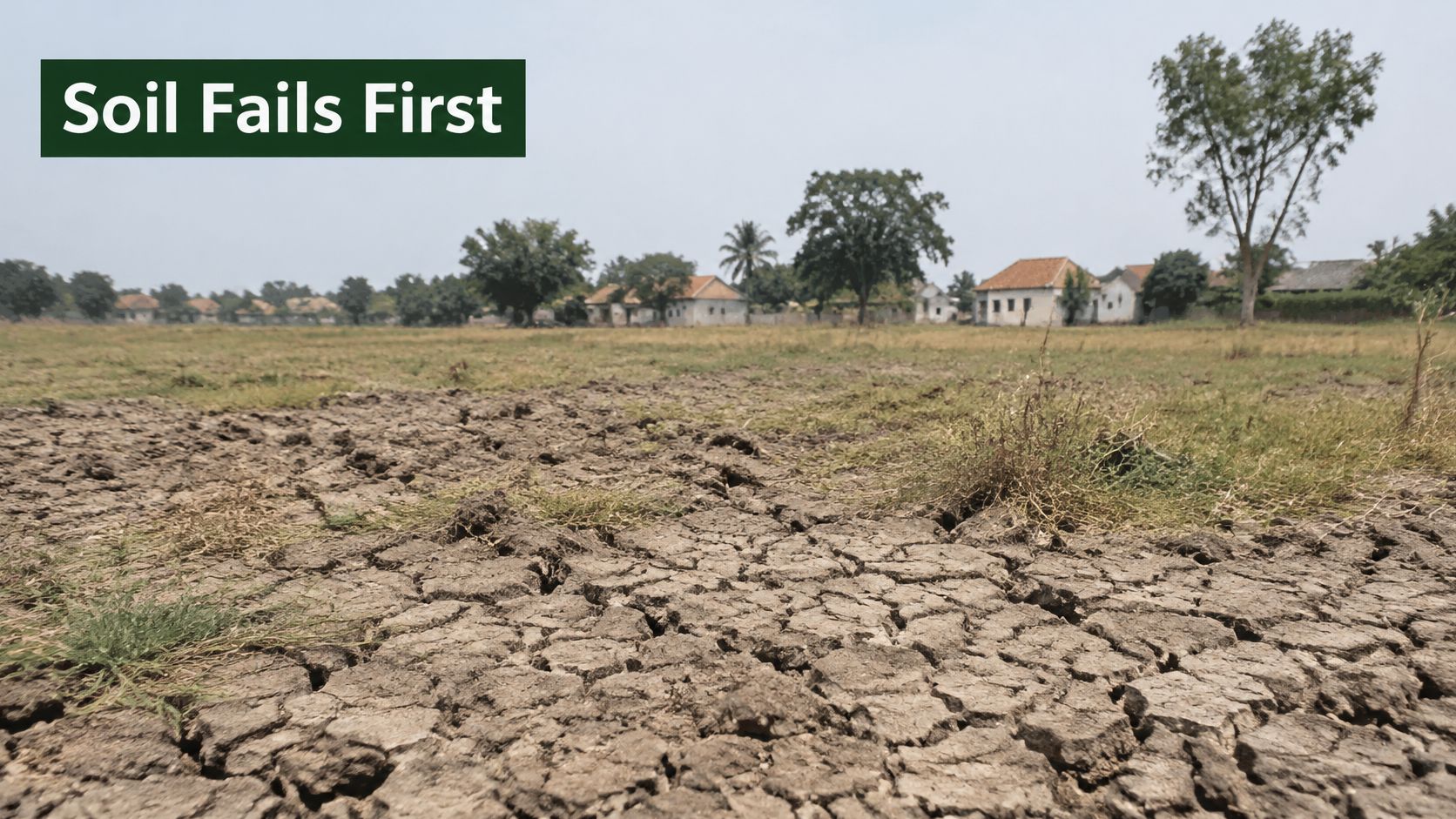
In the UK, desertification is not generally classed as an active national-scale threat. The processes that create desertification-like conditions are already mapped. A review of UK soils finds that more than 2 million hectares of soil in England and Wales are at risk of erosion, and about 3.9 to 4 million hectares are at risk of compaction. Wet-weather field work and livestock grazing damage structure. Heavier machinery packs the layer that should hold water. Intensive cultivation, with fewer years in grass, speeds the loss of organic matter.
Practical rule: If a field ponds in the tramlines and crusts between them, treat that as an early cause, not as bad luck with the weather.
Pollution and a thinner soil food web sit on the same path. Worms, fungi, and roots are what keep pores open. Lose them and infiltration drops long before anyone would call the parish a desert. If land stores less water and supports less growth than before, the causes of desertification are already active, dunes or no dunes.
The Main Causes of Desertification at a Glance
Name the driver before you argue about blame. Most land fails because several rows below are running at once. A wet climate does not cancel the human rows. Bare, compacted, or salted soil fails as a sponge in Lincolnshire just as it does in the Sahel.
| Cause | Driver type | How soil function is lost | Typical setting |
|---|---|---|---|
| Climate variability and drought | Natural, amplified by people | Less cover, drier surfaces, then wind and intense rain remove topsoil | Drylands and drought-hit farmland |
| Overgrazing | Human | Plants are stripped and hooves compact soil so rain runs off | Rangeland and upland pasture |
| Deforestation and land clearance | Human | Roots and canopy that held soil and moisture are removed | Forest margins and dry woodland |
| Poor irrigation | Human | Salts accumulate or waterlogging kills cover and structure | Irrigated arid and semi-arid fields |
| Unsustainable cultivation | Human | Bare soil, slope working and fewer grass breaks cut organic matter and stability | Intensive arable land, including temperate regions |
| Mining, quarrying and construction | Human | Vegetation and topsoil are stripped or compacted and pollution can block reuse | Extraction sites and development land |
| Weak tenure and policy | Human | Short leases and poor enforcement reward extraction over lasting cover | Communal rangeland and weakly regulated frontiers |
Climate, grazing, and clearance
Climate variability and drought thin the living cover first. A long dry spell drops leaf area, so the next wind has a free run at the surface and the next intense shower hits bare crumbs instead of a canopy. People amplify that row when they keep stocking or cropping through the dry year.
Overgrazing is easier to picture at a gate. Animals take the leaf before the plant has rebuilt its root reserves, and hooves on wet or dusty ground close the pores. Rain that should have soaked in sheets off toward the ditch. Upland pasture and open rangeland show this fastest because regrowth is already slow.
Deforestation and clearance remove the two things holding a slope together, roots and shade. A fuelwood cut or a one-off conversion to crops can look like a single season's decision. The soil remembers it for decades, because the mat that slowed rain and fed organic matter is gone. Forest margins and dry woodland are the usual settings, but a hedgerow ripped out on a British slope does a smaller version of the same job.
Water, cultivation, extraction, and rules
Poor irrigation fails in two opposite ways. Too little drainage in a hot climate lifts salts into a white crust that kills the cover. Too much water, held on the surface, drowns roots and collapses structure. Either way the field stops supporting the plants that were protecting it. Irrigated arid and semi-arid basins are the classic sites. A UK grower running irrigation from a clock, rather than from a moisture reading, can waterlog a bed just as effectively.
Unsustainable cultivation is the temperate row people skip. Leaving soil bare over winter, working up and down the slope, and shortening the grass break all cut organic matter and the glue that holds aggregates. Intensive arable land, including ground that gets plenty of rain, loses its sponge this way. The rain is not the rescue. On a sealed surface it is the transport.
Mining, quarrying, and construction strip vegetation and topsoil, or pack what is left under haul roads and lay-down areas. Pollution is the quiet extra. Contaminated soil often cannot be reused as a growing medium, so the functional loss outlasts the diggers. Extraction sites and development land are the obvious settings. A warehouse yard that sheds every storm onto a compacted verge is the everyday version.
Weak tenure and policy don't move soil by themselves. They decide who is rewarded for doing so. A short lease, a communal range with no agreed rest period, or weak enforcement against clearance all pay this year's extraction and bill the next occupier for the missing cover. Several of these rows usually act together. Drought on overgrazed, freshly cleared, weakly policed land is one process, not four separate stories.
Climate stress does not replace these human rows. It multiplies them, which is the next distinction worth making.
How Climate Stress and Land Use Reinforce Each Other
Climate stress and land use act like pressure on both sides of a sponge. Drought thins vegetation, then intense rain can carry topsoil from the exposed surface. As soil loses structure and organic matter, it holds less water, so the next dry spell causes greater stress.
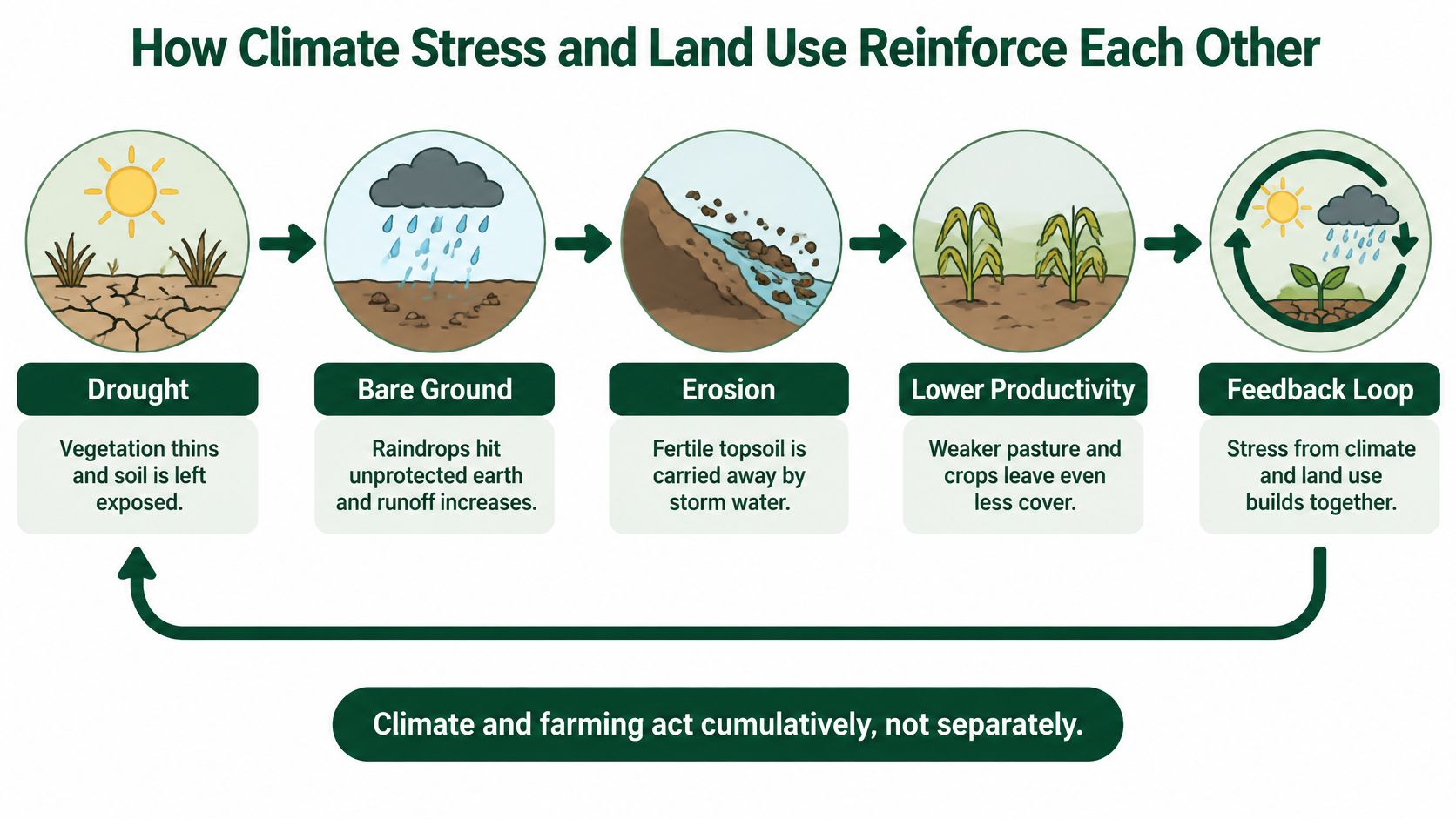
Everyday land use can tighten this loop. Heavy machinery compresses soil; growing one crop repeatedly can leave less varied cover; and heavy reliance on inorganic nitrogen can weaken soil structure and organic matter. When drought or a storm follows, damaged soil absorbs and holds less water. Climate stress and management therefore increase each other's effects, rather than acting as separate causes.
What the exposure looks like in numbers
A Joint Research Centre assessment of arable land across the UK and EU estimated that 43 million hectares were vulnerable to at least one erosion driver: water, wind, tillage or harvesting. About 3.2 million hectares were vulnerable to interacting flood, drought, water-erosion and wind-erosion risks. These figures describe overlapping pressures, not one type of bad weather.
In the UK, prolonged drought lowers soil moisture and can weaken vegetation, leaving the surface more exposed when rain returns. Wetter winters and heavier rainfall also increase the risk of machinery and livestock travelling over ground that cannot support their weight. Much of the UK's lowland peat has been drained for intensive agriculture and horticulture. Drainage allows oxygen into organic soil, driving oxidation, subsidence and carbon loss while reducing the soil's capacity to store water.
Assess a field by considering rainfall intensity, drought length, slope, soil type, organic matter and drainage together. Rainfall alone gives an incomplete picture of its risk.
Keeping soil structure intact can limit erosion and compaction, while reducing greenhouse gas emissions from the oxidation of organic soils. Practical responses include re-wetting peat, avoiding further drainage, retaining crop residues, adding organic inputs, basing irrigation on measured soil moisture and keeping heavy traffic off vulnerable ground. These measures address the same feedback loop through everyday land management.
A short video showing how vegetation loss, runoff and erosion feed into one another can help make the sequence clear.
Where the Same Causes Appear from Drylands to Britain
Start in dryland rangeland, the Sahel being the case many can picture. Drought, heavy grazing, and insecure tenure thin the perennial grasses. Wind then lifts the surface that roots used to pin down. Move to an irrigated basin and the failure changes costume. Poor drainage and salty water leave white crusts, and plots are abandoned because the cover has died, not because the rain stopped entirely. On a forest frontier the cut is sharper. Clearance for crops or fuel removes the root mat that held the slope, and the first heavy season does the rest.
Britain has no national sand sea. It has the same loss of function, measured in tonnes and in carbon rather than in advancing dunes.
| Pressure | Reported scale | What it does to the land |
|---|---|---|
| Annual topsoil loss | About 2.2 million tonnes UK-wide; about 2.9 million tonnes for England and Wales | Removes the productive surface |
| Arable land with erosion signs | More than 17% | Shows the problem is widespread on worked soils |
| Water-erosion risk on arable land | About 44% of UK arable land | Leaves fields exposed in intense rain |
| Upland peat, shallow and rocky soils eroding | About 20% | Strips thin soils that form slowly |
| Cultivated-site erosion rate | Typically up to 10 tonnes per hectare a year; maxima about 66 | Can exceed the rate new soil forms |
| Arable records above tolerable loss | 16% of more than 1,500 records | Soil left faster than it forms |
| Soil organic carbon change, England and Wales, 1978-2003 | Average decline of 0.6% a year | Weakens water storage and drought resilience |
| Share of UK land in agriculture | About 71-72% | Makes field practice a national soil issue |
How to read the UK rows
Parliamentary and government erosion assessments put annual topsoil loss at about 2.2 million tonnes from UK land, and about 2.9 million tonnes from England and Wales. These are two estimates for overlapping geographies, not a single audited total, so don't add them. More than 17% of arable land shows signs of erosion. Water-erosion risk is estimated to affect about 44% of UK arable land, and around 20% of upland peat, shallow, and rocky soils are currently eroding. Thin upland soils form slowly. Losing them is not a one-season dent.
On intensively cultivated arable sites, measured annual erosion is typically up to 10 tonnes per hectare, with reported maximums of 66 tonnes per hectare. A single severe storm on bare or compacted ground can take still more. That is the link back to the sponge. The soil that leaves in a brown flood is the layer that stored water and fed the crop.
Carbon, and the gap in the books
Soil organic carbon in England and Wales fell by an average of 0.6% a year between 1978 and 2003. Land-use change, peat drainage, ploughing, mineral fertiliser use, and fewer grass years in the rotation all contributed. Longer dry spells and higher temperatures reduce cover further and leave that poorer soil more exposed to drought. There is still no coordinated national programme that tracks erosion against the rate new soil forms, so managers are often comparing a muddy gateway with last year rather than with a formation benchmark.
A national assessment of more than 1,500 erosion records found that 16% of arable records showed loss above tolerable rates, meaning soil left faster than it formed. Agriculture occupies about 71-72% of UK land, so field practice is a national soil issue, not a niche one. A business with fields, landscaping, or haul routes can create the same bare, compacted conditions on a few hectares. The mechanism does not wait for a dryland climate.
What Lost Soil Costs Ecosystems and Livelihoods
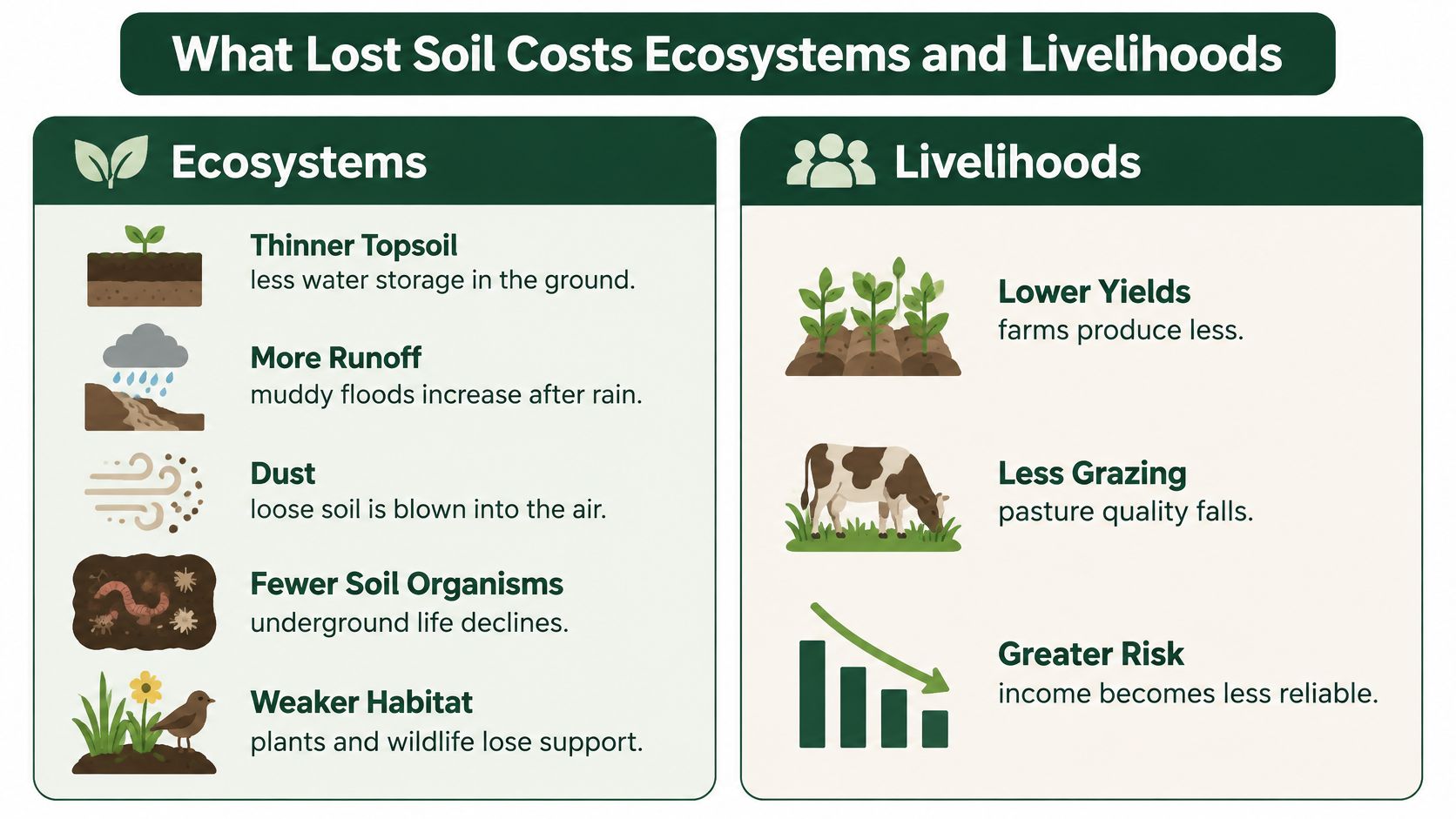
Soil loss is measured in more than tonnes carried away. When soil holds less water and supports fewer plants, ecosystems and livelihoods both lose resilience.
Ecological damage
Thinner topsoil stores less water, so more rain runs off instead of soaking in. Runoff can carry soil into rivers, while wind lifts unprotected earth as dust. As soil structure and organic matter decline, fewer organisms can live in its pores, and the habitats above ground can thin with them. Organic matter loss also releases carbon from the soil, adding to climate stress.
Salt, compaction and pollution can make recovery slower by limiting the conditions roots and soil organisms need. The consequences of changing river flows and sediment loads are also visible in large dam projects. The Three Gorges Dam and its effects provide a related example of how water infrastructure can affect communities and rivers, though soil degradation is a separate process.
Livelihoods and the bill
When land produces less, farmers and herders may face lower yields and fewer reliable sources of pasture and water. Competition for those resources can add pressure to communities. Some families leave land that no longer supports their livelihoods; others must contend with soil washing away from fields or accumulating salts that limit its use.
The economic cost is already substantial in England and Wales. A JNCC signpost report hosted on Defra's website estimates the annual cost of soil degradation at about £1.2 billion. Loss of organic carbon, compaction and erosion reduce soil's ability to store water and support fertility. The resulting costs can include extra fertiliser, flood damage and weaker resilience to drought, affecting farm finances and public budgets.
Preventing soil loss costs less than rebuilding topsoil. New soil forms over decades to centuries, and no input invoice can buy that time back.
Land Management Responses That Break the Cycle
Each control below interrupts a specific failure. Skip the mechanism and the action becomes a slogan.
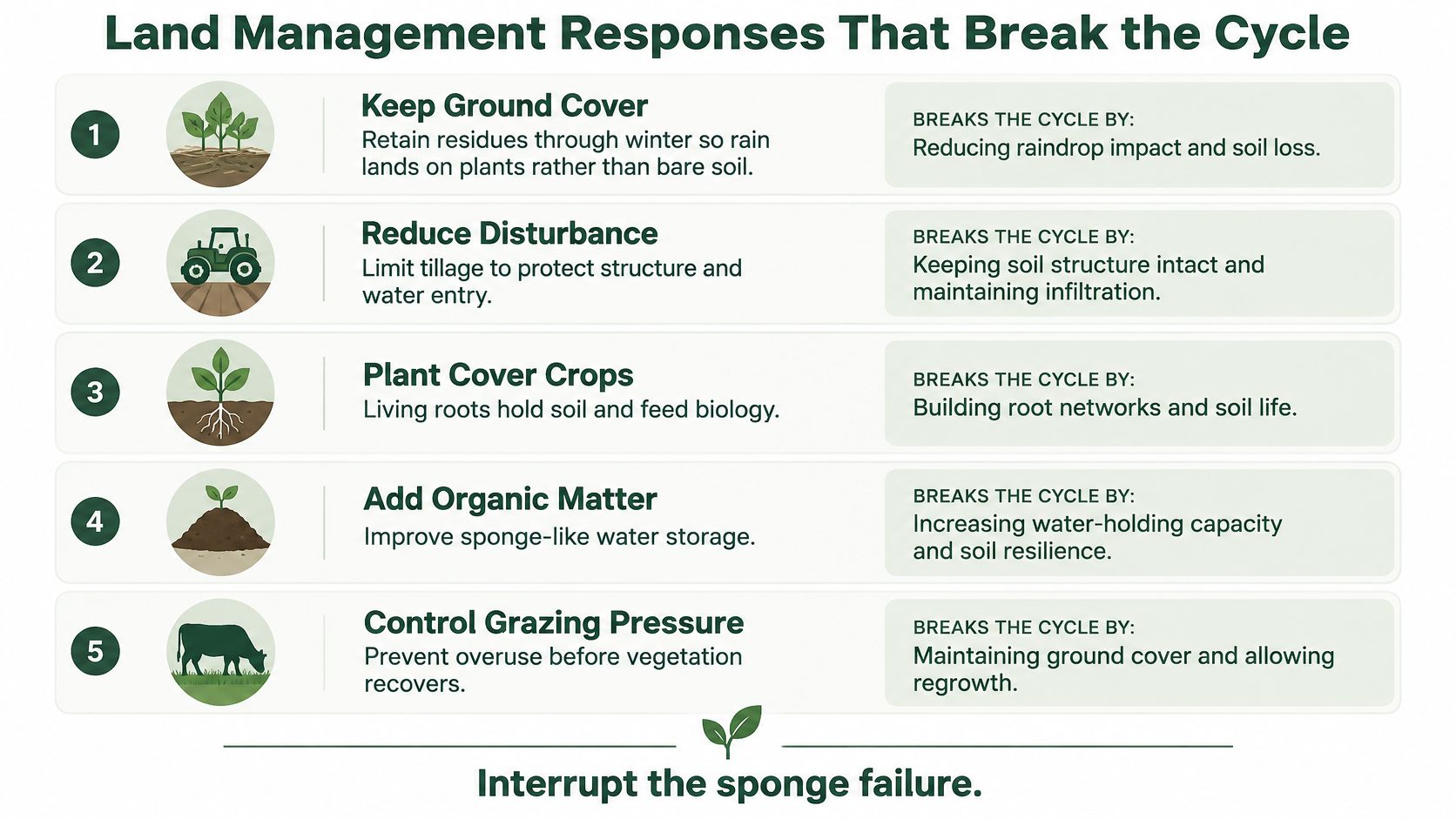
Keep ground cover through winter, and keep the residues. Rain should land on leaves and stubble, not on bare crumbs. That limits surface sealing and the splash that detaches soil. A cover that is thin but continuous beats a tidy, bare seedbed on a slope.
Disturb less, and turn the work along the contour. Cultivation up and down a slope gives intense rain a channel. Contour-aligned passes slow that flow. Reducing disturbance protects the aggregates that let water in. On a steep field, the right answer is often to stop cropping it the way you crop the flat.
Keep heavy kit off wet ground. Trafficking a wet field cuts aggregate stability and compacts the layer that holds water. Separate traffic from sensitive periods. A trafficked headland that ponds is not a drainage problem you can mole away. It is a timing problem.
Watch the numbers before the storm proves them. Bulk density, infiltration, organic matter, and visible rills tell you the sponge is failing while you can still change the rotation. A spade and a simple infiltration ring will show more than a yield map alone.
On peat, re-wet or stop further drainage. Oxidation and subsidence are the mechanism. Leaving the water table low "for one more cropping season" extends both.
Irrigate from measured soil moisture, and drain so salts leave rather than roots drowning. Clock-based irrigation ignores whether the profile is already full. In dry regions, drainage that only waterlogs the bed trades one failure for another.
Put grass or mixed breaks back where continuous cropping has mined carbon, and match grazing to regrowth. Protect the recovering patch instead of letting stock straight back on. Flower-rich breaks can do double duty. Choosing plants that support bees keeps living roots in the ground and feeds pollinators while the soil rebuilds.
On mines and construction sites, strip and store topsoil, limit the compacted footprint, and reinstate cover quickly. A haul road that was "temporary" for two winters is a compacted stripe that sheds water onto everything downslope.
Parliamentary analysis of UK agriculture and the environment is clear on the operational trigger. Bare soil, cultivation up and down slopes, cropping steep land, and trafficking wet fields reduce aggregate stability and increase detachment when rain is intense. Ground cover, less disturbance, contour working, and staying off wet ground are the direct counters. Weakened soils then produce more runoff in storms and hold less water in dry spells, which is the loop you are trying to break.
Rules, contamination, and what "better" looks like
Policy comes after practice, not instead of it. Secure tenure, enforcement against casual clearance, and payments that reward cover and soil carbon rather than yield alone change who can afford to rest land. The edge case is contamination. Adding organic matter without testing can move plastics, chemicals, or pathogens onto ground you meant to improve. Traceable sources matter as much as the tonnes applied.
Within a season, good looks like more cover, fewer rills, water soaking in rather than ponding, and bulk density plus organic-matter tests moving the right way. Deeper carbon recovery takes years. Don't expect a single winter of stubble to rebuild what a decade of bare tillage removed.
Put Soil Resilience on the Business Agenda
Desertification is not only sand spreading across dry land. It is also soil losing the ability to hold water, carbon and nutrients. That loss can matter to UK businesses too, where compacted ground and wasted organic resources weaken soil function in a wet climate.
For facilities and operations managers, the practical questions are about material and land use. Are suitable organic materials being discarded? Do vehicles or temporary compounds compact ground that should absorb rain? Could poorly separated or contaminated material create risks if it is returned to land?
Organic waste has recovery potential, but only when the material is suitable and handled under the rules that apply. Poor segregation can close routes into compost, digestate or other soil-improvement uses. Cutting emissions alone does not restore soil structure, while adding organic matter without contamination controls can create new risks. Track waste prevention and soil outcomes together so that progress on one measure does not obscure a loss of soil function.
England's developing soil indicators, reported through JNCC soil-health indicator work, put rural soils at 63.5% for their contribution to reducing surface-water flood risk and 59.6% for long-term carbon storage. Wetter winters, warmer summers, heavier rain, drought and more frequent storms can raise erosion and compaction risks alongside heavier machinery, overgrazing, specialised cropping and heavy reliance on inorganic nitrogen. Waste handling is part of the picture: organic carbon sent to disposal cannot help rebuild soil stores.
A review you can start this month
Walk one site and write four lines.
- Safe return: Which organic streams could go back to land under the rules that apply?
- Blocked streams: Which loads are too contaminated or poorly separated for a soil-improvement route?
- Traffic: Where do lorries, stillages or temporary compounds compact ground that should absorb rain?
- Evidence: Could your paperwork show the material's end destination, not just the tonnes collected?
Compare those answers with soil checks on land you manage or supply: bulk density, infiltration, organic matter and visible rills. If the gap is collection, compliance or data, address it as an operational issue with a clear paper trail.
Gegan designs compliant, data-led waste and recycling systems for UK businesses, including food waste and other organic streams that may support soil recovery when contamination is controlled. Its services can help businesses track material streams and end destinations. Visit Gegan to map your streams and reporting against the soil outcomes you need.